Tag: decolonial design

  • The Dungeon Master and the Console: Reimagining Power in TTRPG Narratives

    The Dungeon Master and the Console: Reimagining Power in TTRPG Narratives

    We begin not with a map, but with a murmuration.

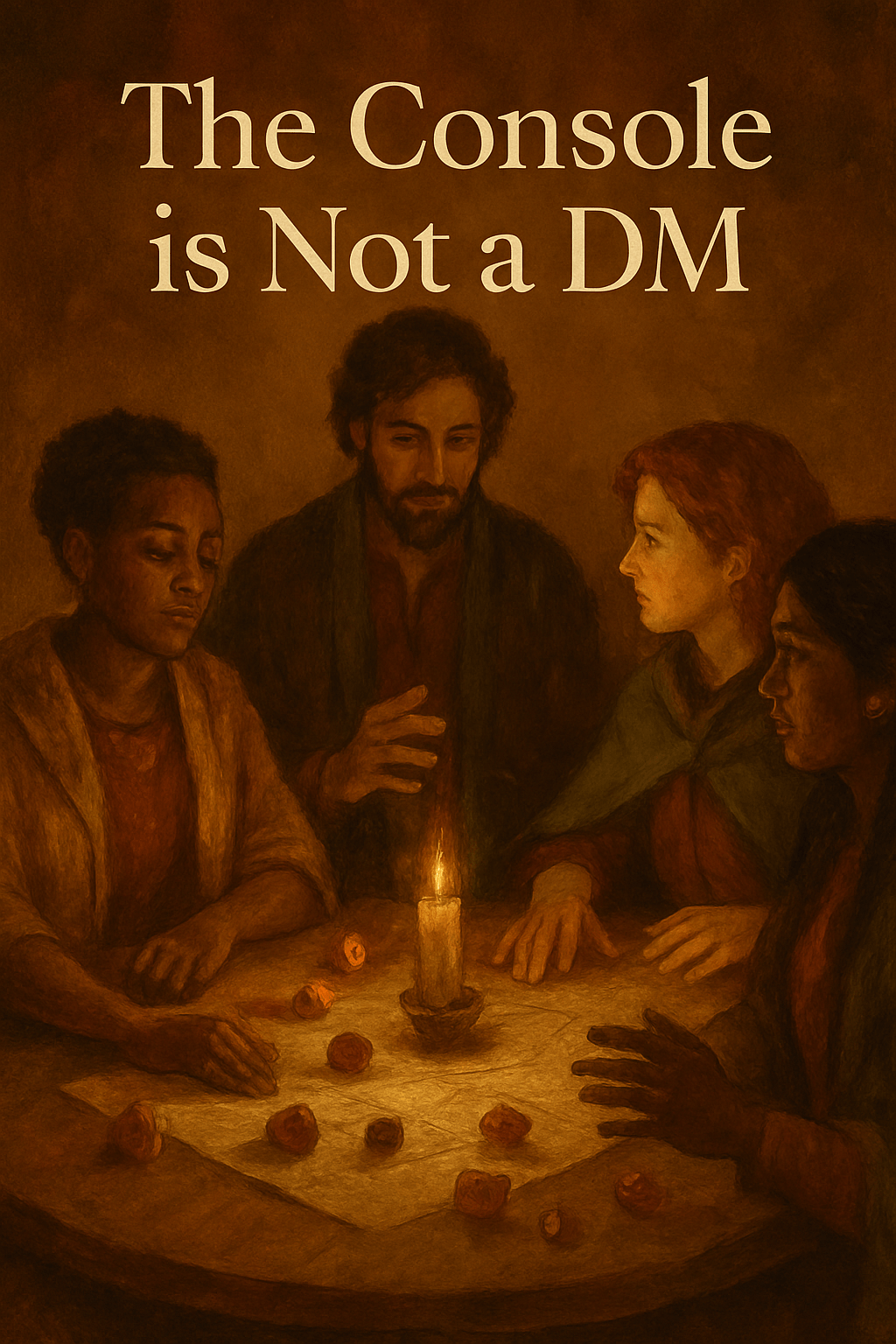
    Not a straight road. Not a plotted path. But a circle of friends and an invitation to play—to drift, to discover, to worldbuild sideways. Dice in hand, snacks on the table, we don’t crown a Master. We form a conspiracy.

    This is the Console.

    In tabletop roleplaying games (TTRPGs), the Dungeon Master has long been framed as the linchpin, the omniscient narrator, the architect of fate. And yet, the stories that matter—the ones we remember, retell, tattoo into memory—rarely belong to the DM alone. They live in the breath between players. In the choices that surprise us. In the glitches. In the laughter.

    The term “Dungeon Master” is soaked in the logic of control. It implies hierarchy, surveillance, ownership. You master the dungeon. You master the game. But who gets left behind in that story? Whose voices are silenced?

    I come to this from years of lived play. Our campaign, The Emissary Trials, ran for over three years. Queer, trans, Filipinx, Ghanaian, devout and defiant—our table was a communion of difference. And over time, I found I no longer wanted to be the Master. I wanted to be a gardener. A host. A conduit.

    So I let go.

    The Console emerged.

    Where the DM commands, the Console collaborates.

    Where the DM prepares plot, the Console prepares space.

    The Console is a facilitator of possibility, a designer of containers, a steward of emergent narrative. The Console trusts the players to surprise them. They know the map will never be complete—and that’s not a flaw. That’s the whole point.

    Inspired by adrienne maree brown’s facilitation-as-service, Donna Haraway’s sympoiesis, and Fred Moten’s idea of study in the undercommons, I approached the role not as author but as accomplice. I asked questions instead of giving answers. I let players invent lore.

    In The Undercommons, Moten and Harney describe study as what happens in the margins. Not a lecture, but a jam session. Not a syllabus, but a riff. That’s what our sessions became: fugitive study. We were playing, yes—but also theorizing, improvising ethics, dreaming otherwise.

    A game night became a moment of ungoverned pedagogy. We negotiated with dragons instead of slaying them. We wrote prophecy as poetry. We disrupted the empire from within and called it care. At the center of it all was the Console—not leading, but listening.

    What the Console Offers

    • Power reimagined. The Console decentralizes authorship.
    • Worldbuilding as dialogue. The game world grows from player decisions, not a preset plot.
    • Emergent narrative. The story spirals from play, not prep.
    • Transdisciplinary design. Drawing from literature, theory, activism, performance.

    The Console is not a panacea. It requires trust, labor, and unlearning. It asks the facilitator to decenter themselves. But the reward is a campaign where everyone becomes a worldbuilder, a poet, a keeper of the flame.

    What if the most radical thing you can do as a facilitator is to stop mastering?

    What if you made the table a site of transformation, not transmission?

    What if the best maps are the ones you draw together—wrong turns, missing legends, whispered names?

    This is the invitation of the Console:
    Play not to control. Play to find out.

  • Remix as Resistance: Worldbuilding Beyond Colonial Fantasy

    Remix as Resistance: Worldbuilding Beyond Colonial Fantasy

    The dragons are not the problem.

    It’s the map. It’s the castle. It’s who gets to call themselves the hero.

    When we gather around the table to play a game—dice in hand, worldbooks stacked, character sheets printed—we’re often stepping into a dream space built from borrowed materials. The swords are familiar. The ruins feel lived in. We know where this is going. Except we don’t have to. We never had to.

    Fantasy has always been a remix. Dungeons & Dragons itself is a bricolage: Tolkien, Moorcock, Campbell, medieval history, pulp magazine nostalgia. But it’s also been uncritical—restaging colonial myths as heroics, flattening cultures into “races,” and naming domination as destiny. We are told this is the way of the world.

    In my three-year campaign set in Nufrixia, we asked: What if it isn’t?

    Nufrixia was never meant to be a coherent world. It was a carrier bag, to use Ursula K. Le Guin’s term—a container for fragments, for multiple truths, for what might be gathered rather than conquered. Our world didn’t mirror one mythology, one culture, or one aesthetic. It was a tapestry of elder gods with names like Mu, Sek, and At—pan-linguistic signifiers of divinity both ancient and estranged.

    Instead of defaulting to the medieval monoculture of most fantasy, our great metropolis, Seldom City, was a fusion: think Babylon meets Detroit, steampunk meets desert shrine. Another region, coined “Detroit” by my players, blended decaying industrialism with arcane tech and resistance lore. These weren’t just stylistic choices—they were structural refusals. We were building outside the empire’s blueprint.

    The remix didn’t stop at geography. It permeated the very logic of our characters. We refused D&D’s standard “race” categories, which too often essentialize morality and culture. Instead, players built their own heritages:

    • One was born from a guild of inventors shunned by the empire—no species, just status.
    • Another was star-marked, descended from a nomadic group who tracked fallen celestial bodies across the archipelago.

    We didn’t ask what box your character fit into. We asked: What stories shaped you?
    The result was a cast untethered from bioessentialist tropes, grounded instead in community, memory, and myth.

    We also remixed the paladin. No longer a holy knight tethered to a single faith, the paladin in Nufrixia became an Oathkeeper—a protector of the people, a servant of causes. One swore allegiance to the orphan wards of a crumbling quarter. Another defended the remnants of a vanished faith.

    This was not just flavor—it was a political design choice. The mechanics had to bend, not the players.

    In standard campaigns, the evil empire looms large: a monolith to topple, a convenient target. But what happens when the rebellion isn’t clean? When power must be negotiated, infiltrated, reimagined?

    Our players didn’t overthrow the empire. They co-opted it.

    They carved out autonomous zones. They revived suppressed rituals. They served as ministers by day and saboteurs by night. They asked, again and again: What does liberation look like within?

    By the end of the campaign, they hadn’t burned the empire to the ground. They had sown wildflowers in its cracks. This wasn’t revolution as spectacle—it was speculative transformation, slow and strange.

    We didn’t follow the script. We made new pages.

    This is where Sofia Samatar’s work sang to me. Her writing on speculative fabulation and the remix speaks to the precise act we were engaging in: taking the tools of empire—genre tropes, fantasy aesthetics, the D&D chassis itself—and twisting them toward new ends.

    Samatar writes of marginalized storytellers who “repurpose the discarded sign,” finding utopia in the overlooked. That was us. That was our play. D&D was the master’s tool, but we used it to build something it never imagined.

    Fantasy, at its best, isn’t about dragons or dungeons. It’s about the possibility of something else. A world unmoored from dominance. A table where everyone authors. A myth that stares into empire and says: Not like this. Not again.

    This philosophy—of remix, of refusal, of reimagination—transformed my role from Dungeon Master to Console. No longer the cartographer of a known world, I became a custodian of negative space. I left gaps on purpose. I welcomed improvisation not as derailment but as direction. I said yes to what was strange.

    Together, we found that the best campaigns are not polished stories. They’re laboratories. They’re prayers. They’re studies in how to play otherwise.

    Final Thought

    So yes, bring your dragons. But let them speak Swahili or code-switch or quote Baldwin. Let the knights wear leather jackets and carry tea instead of swords. Let the map curl, spiral, explode.

    Remix it all. Make the game strange again. Because the fantasy worth playing is the one that imagines the world could be different.


    What fantasy tropes have you broken lately? How have you decolonized your worldbuilding—or want to start? Share your remixes below!