
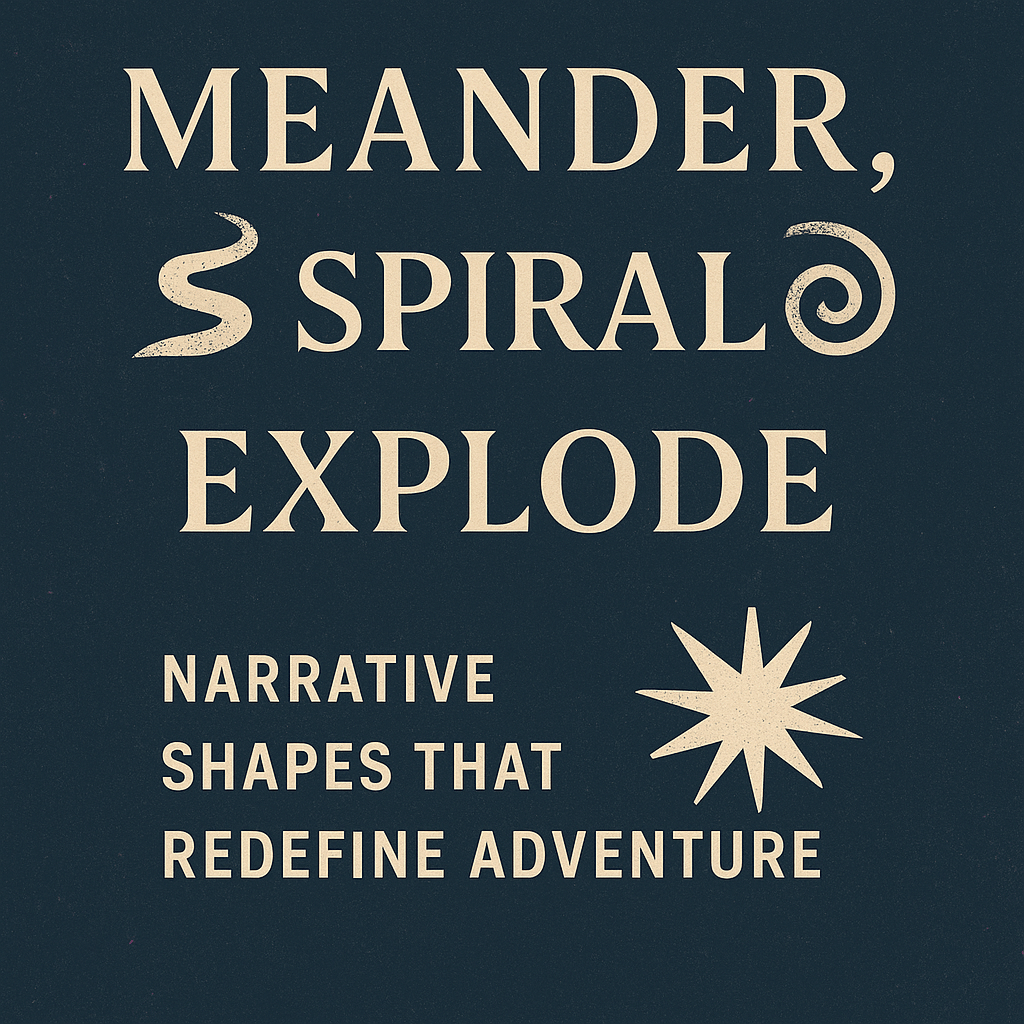
Adventure doesn’t always look like a straight road.
Sometimes it drifts like smoke from a ruined temple.
Sometimes it curves back on itself, returning to old questions in new forms.
Sometimes it detonates, throwing narrative shrapnel in every direction.
In tabletop roleplaying games (TTRPGs), we’ve been taught that stories must build toward a climax. That there is a beginning, a middle, and an end. That the good story—the heroic story—is one where tension rises, the villain is confronted, and the world is saved (or not). But what if that shape is too narrow for the kinds of stories we actually want to tell?
In Meander, Spiral, Explode, literary scholar Jane Alison challenges the dominance of the classic Freytag triangle—the rise, climax, fall structure that so often shapes modern narrative. She offers other possibilities: stories that meander like rivers, spiral around themes, or explode outward like constellations.
This language opened up something in me as a game designer and facilitator. What if campaigns didn’t have to march toward a final boss? What if they could breathe, wander, double back, or bloom unpredictably?
In our long-running campaign set in Nufrixia, we experimented with these shapes. And the results were some of the richest storytelling I’ve ever experienced.
Some of our best sessions came from detours. A bar fight that began as a throwaway encounter became the start of a rival gang subplot. A romance between two PCs started as a joke, then gained emotional depth over time. These weren’t distractions—they were the campaign.
In a meandering narrative, the path is the story. The joy is in discovery, in the way things build through accumulation, not escalation. This style invites the players to linger, explore, and shape the world with their curiosity.
Other moments followed a spiral. A central theme of our campaign—fate vs. free will—surfaced again and again. Not in one grand showdown, but in pieces: a cursed object, a prophecy recited by a child, a looping timeline encounter in a temple of lost gods.
Each time the question returned, it felt different. The players changed. The world changed. The spiral brought depth, not repetition. We weren’t answering a question—we were living in it.
And then there was the explosion. Midway through the campaign, a player’s backstory collided with a major faction, splitting the party and the world into multiple timelines. From that rupture, three simultaneous arcs bloomed. The players followed different threads, converging weeks later for a reckoning that felt earned, not forced.
Explosive narratives are fractal. They don’t resolve easily. They sprawl, and the Console’s role is to hold space for all of it—to let the fireworks bloom and trust the group to find meaning in the debris.
Learning to see story as shape also changed how I paced sessions. Some nights we skimmed through weeks of travel in montage. Others, we slowed time to a crawl: a courtroom debate, a night under the stars, a tense negotiation with a ghost.
Like music, a campaign needs rhythm. Variation. Texture. Quiet moments before crescendos. Ellipses and digressions. A good story isn’t just what happens—it’s how it feels to move through.
As Console, I don’t write plots. I shape flows. I plant thematic seeds and watch how players spiral toward them. I design for resonance, not resolution. That means leaving gaps, inviting tangents, and trusting that meaning will emerge not from control, but from connection.
This approach requires you to listen. Not just to what players want, but to the shape of the story they’re creating together.
So let go of the triangle. Let your campaign meander. Let it spiral.
Let it explode.
What shape has your campaign taken? Have you ever played a story that spiraled, or burst wide open? Share your narrative patterns in the comments—I’d love to hear how you’re bending the map.
 KOSI DUNN